

• NED legacy APIs are deprecated and cannot access data ingested after January 2026. Please use the new NED APIs ⤦.
NED Local Volume Sample
The NED Local Volume Sample (NED-LVS) is a subset of over 2 million objects in NED with distances out to 1000 Mpc. The distances selected for NED-LVS are based on both redshifts (~99%) and redshift-independent distances, where the latter are prioritized at distances less than 200 Mpc. Photometry from all-sky surveys (GALEX, 2MASS, and AllWISE) that have been joined into NED are also extracted, with ~90% of NED-LVS objects having at least one measurement. These fluxes are used to derive physical properties (SFR and stellar mass) and to estimate the completeness relative to expected local luminosity densities.
The galaxies in NED-LVS can be used for studies in many areas of astrophysics that include: star formation, galaxy evolution, large scale structure, galaxy environments, and searches for the electromagnetic counterparts to gravitational wave events, to name a few. The data in NED are updated regularly, and NED-LVS will be updated concurrently. Consequently, NED-LVS will continue to provide an increasingly complete sample of galaxies for a multitude of astrophysical research areas for years to come.
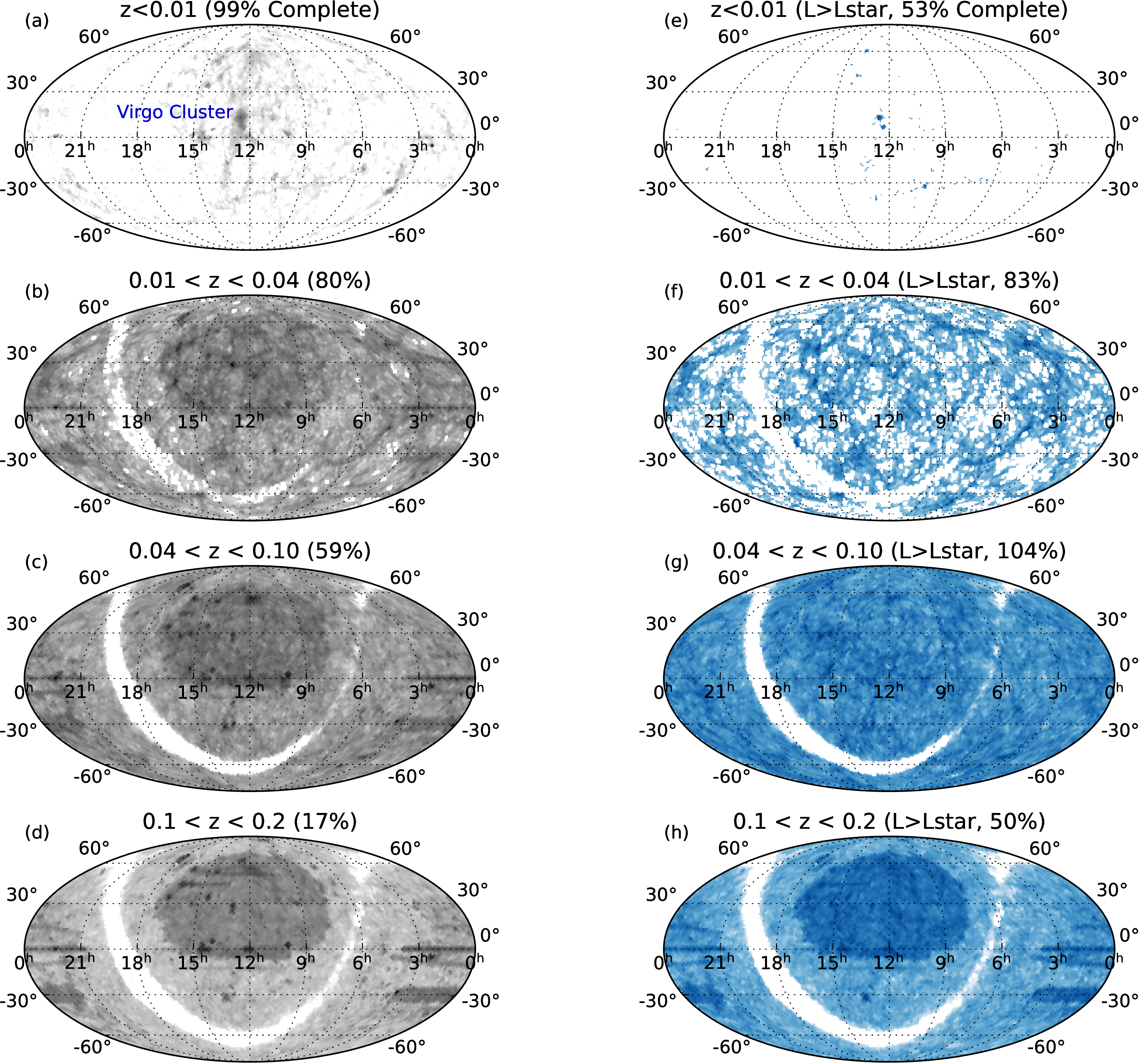
To estimate the completeness of the galaxy census per unit volume in NED-LVS, we define completeness as the ratio of the total luminosities of galaxies to the total luminosity expected from integrating under published galaxy luminosity functions. The completeness relative to NIR luminosities (which traces a galaxy's stellar mass) is roughly 100% at D<30 Mpc and remains moderate (70%) out to 300 Mpc. For brighter galaxies (>L✱), NED-LVS is ~100% complete out to 400 Mpc. The Figure below gives the density of NED-LVS objects in distance shells where completeness in the shell is given in the parentheses. For more details about NED-LVS see Cook et. al (2023)↗.
(~1 GB FITS table)
Latest Update to NED-LVS
The April 2026 version of NED-LVS now has galaxy angular diameters. Observed angular sizes, or diameters, are fundamental measurements of galaxies that provide a means to understand galaxy evolution, and can be critical in Time Domain and Multi-Messenger (TDAMM) astronomy to help identify the hosts of transient events. NED-LVS provides fiducial angular diameters that are useful for many applications, which are described in the section below titled "Documentation for data added after NED-LVS paper"; however, we provide a few highlights here:
- The composition of objects in the April 2026 version is the same as that of the June 2025 version, but now includes angular diameters.
- The fiducial diameters are selected from 4 sources (in priority order): the 2020 version of Siena Galaxy Atlas (SGA; Moustakas et. al 2023↗) isophotal D25SGA in the r-band, the Sloan Digital Sky Survey (SDSS; York et al. 2000↗) isophotal D25SDSS in the r-band, the Two Micron All Sky Survey (2MASS; Skrutskie et al. 2006↗) "total" aperture diameter (Dtot2MASS) in the Ks-band, and those from older photographic plate surveys (e.g., RC3; de Vaucouleurs et al. 1991↗) isophotal D25PLATE in the B-band.
- Our analysis shows that the chosen diameter definitions provide statistically similar values across surveys, diameter definitions, and filters (see full description for more details).
- 81% of NED-LVS objects have been assigned a fiducial angular diameter, where 15.7% are from SGA, 35.1% are from SDSS, 29.9% are from 2MASS, 0.1% (N~2,100) are from PLATE surveys.
- We also provide a list of known issues and caveats that affect a small percentage of objects with diameters in the full description.
Update History
June 2025 (labeled "2025-06-06")
The June 2025 version of NED-LVS includes new objects ingested by NED from the literature and the removal of newly identified non-galaxy contaminants. This revision contains a total of 2.10M objects, an increase of 33K (1.6%) over the previous version.
Each release of NED-LVS is accompanied by an additional round of vetting of both newly ingested objects and subsets of the previous version to ensure a robust and highly complete census of the local Universe. Listed below are the details of redshift updates and contaminants identified and removed by our vetting efforts.
- 2.1K updated redshifts: objects whose previous redshifts were determined by the NED team to be questionable or objects with newer, more reliable measurements have been updated.
- 3.5K "stars" (57.3% were in the previous version): objects determined to be stars in our Galaxy via a combination of visual inspection and high stellar probabilities from either GAIA DR3 astrophysical parameter metrics (Creevey et al. 2023↗) or the machine learning catalog of Tachibana et al. (2019)↗ based on PanSTARRS1 objects.
- 1.5K parts of galaxies ("PofGs"; 99.7% were in the previous version): objects that reside in or near large angular-sized galaxies that have been determined via visual inspection and supporting metadata (redshifts, publication classifications, etc.) to be a sub-component of a galaxy. These PofGs can be many types of physical objects such as HII regions, planetary nebulae, star clusters, etc. During our vetting, we have flagged additional spectroscopic fiber position sources (e.g., SDSS and DESI) that are located outside of the central part of the galaxy as PofGs, unless there is no other object with a redshift for that unique galaxy. Note: PofGs were flagged for future updates to object types in the NED database, and they are omitted from the LVS galaxy sample.
- ~700 "Unmatched data" (99.7% were in the previous version): objects that contain data for existing galaxies in NED that should be merged. Generally these are additional observations of large nearby galaxies whose positions or names are discrepant enough from an existing object to result in an ambiguous match. Only obvious matches via visual inspection have been identified and flagged. Note: These flags will help to make more accurate crossmatches in the NED database at a later date, and the unmatched data have been removed from LVS (without the loss of vital distance information) to avoid duplication of unique galaxies.
- Caveats: In general, any "Unmatched data" and "PofGs" in a galaxy sample would result in over-counting the true number of distinct galaxies in the local volume. Identification of these objects is an on-going process and each successive release of NED-LVS will identify and remove additional contaminants.
January 2025 (labeled "2025-01-28")
The January 2025 version of NED-LVS includes new objects ingested by NED and the removal of newly identified non-galaxy contaminants. This updated version contains a total of 2.07M objects, an increase of 203K (10%) over the previous version, where 30K of the newly added objects (after contaminant removal; see below) are from the literature and 173K originate from the Dark Energy Spectroscopic Instrument Early Data Release (DESI-EDR; DESI Collaboration, 2024↗).
Each release of NED-LVS is accompanied by an additional round of vetting of both newly ingested objects and those from the previous version to ensure that this sample will provide a robust and highly complete census of the local Universe. Listed below are details of redshift updates and contaminants identified and removed by our additional vetting for this version of LVS.
- 151K "stars" (0.8% were in the previous version): objects determined to be stars in our Galaxy via one or more of the following reasons:
- stellar spectroscopic classifications and redshifts from DESI-EDR consistent with being members of the Milky Way.
- objects with high stellar probabilities from either GAIA astrophysical parameter metrics or the machine learning catalog of Tachibana et al. (2019)↗ based on PanSTARRS1 objects.
- 5K parts of galaxies ("PofGs"; 20.8% were in the previous version): objects that reside in or near large angular-sized galaxies that have been determined via visual inspection and supporting metadata (redshifts, publication classifications, etc.) to be a sub component of a galaxy. These “PofGs” can be many types of physical objects such as HII regions, planetary nebulae, star clusters, etc. During our vetting, we have flagged additional spectroscopic fiber position sources (e.g., SDSS and DESI-EDR) that are located outside of the central part of the galaxy as “PofGs”, unless there is no other object with a redshift for that unique galaxy. Note: PofGs were flagged for future updates to the NED database, but omitted from the LVS galaxy sample.
- ~1200 updated redshifts (27.2% were in the previous version): objects with fiducial redshifts that were determined by the NED team to be questionable and were replaced with more reliable measurements. Of the objects with updated redshifts, 859 now have distances beyond the 1000 Mpc limit currently imposed on NED-LVS and have been removed from the sample.
- ~600 "Unmatched data" (74.3% were in the previous version): objects that contain data for existing galaxies in NED that should be merged. Generally these are additional observations of large nearby galaxies whose provided positions or names are discrepant enough from an existing object to result in an ambiguous match. Only obvious matches via visual inspection have been identified and flagged. Note that these flags will help to make these crossmatches in the NED database at a later date, and that the unmatched data has been removed from LVS (without the loss of vital distance information) to avoid duplication of unique galaxies.
- Caveats: In general, any "Unmatched data" and "PofGs" in a galaxy sample would result in over-countering the true number of distinct galaxies in the local volume. Identification of these objects is an on-going process and each successive release of NED-LVS will identify and remove additional contaminants.
July 2023 (labeled "2023-09-22v2")
This version of NED-LVS contains updated redshifts for 271 objects with more reliable measurements. Of the objects with updated redshifts, 69 have distances beyond the 1000 Mpc limit currently imposed on NED-LVS and have been removed from the sample.
NED-LVS Columns
Click here for descriptions of the current NED-LVS columns
| Column | Data Type | Unit | Description |
|---|---|---|---|
| objname | S | -- | Preferred object name in NED |
| ra | D | deg | Right ascension [J2000] |
| dec | D | deg | Declination [J2000] |
| objtype | S | -- | Preferred object type in NED |
| z, z_unc | F | -- | Fiducial redshift [heliocentric] |
| z_tech | S | -- | Technique used to measure redshift [SPEC, PHOT, UNKN, INFD, MOD, NULL] |
| z_qual | B | -- | Qualifier flag indicating reliability of redshift [True=unreliable] |
| z_qual_flag | B | -- | Boolean flag indicating that the z_qual flag has been updated in NED-LVS |
| z_refcode | S | -- | Reference code for the publication that provided the redshift |
| ziDist, ziDist_unc | F | Mpc | Redshift-independent distance computed as the weighted average of measurements in either the primary or secondary indicators |
| ziDist_method | S | -- | Method used to measure the redshift-independent distance when a single method is used to compute the weighted average, otherwise "Wavg" when a mixture of methods are used [Cepheid, SNIa, TRGB, Wavg, etc.] |
| ziDist_indicator | S | -- | Measurement type indicator for redshift-independent distance [Primary or Secondary] |
| ziDist_refcode | S | -- | Reference code for the publication that provided the distance when a single measurement was chosen, otherwise "Mix" indicates an average of multiple measurements was used [refcode or Mix] |
| DistMpc, DistMpc_unc | F | Mpc | Selected distance used in NED-LVS |
| DistMpc_method | S | -- | Method used in the selected distance [Redshift or zIndependent] |
| Diam | F | arcsec | Angular major-axis diameter (2a) |
| Diam_ra | D | deg | Right Ascension (J2000) from the survey indicated in Diam_survey |
| Diam_dec | D | deg | Declination (J2000) from the survey indicated in Diam_survey |
| Diam_ba | F | -- | Minor-to-major axis ratio |
| Diam_pa | F | deg | Ellipse position angle (measured east of north) |
| Diam_survey | S | -- | String indicating the survey that made the diameter measurement [SGA, SDSS, 2MASS, PLATE] |
| Diam_filt | S | -- | The filter with which the diameter measurement was made [B, r, Ks] |
| Diam_refcode | S | -- | Reference code for the publication that provided the diameter |
| Diam_qual | B | -- | A boolean quality flag indicating that the diameter properties may be highly uncertain [True=uncertain] |
| ebv | F | mag | Foreground MW reddening E(B-V) from Schlafly & Finkbeiner (2011) |
| A_FUV_MWext | F | mag | MW extinction in GALEX FUV-band assuming Fitzpatrick et al. (1999) |
| A_NUV_MWext | F | mag | MW extinction in GALEX NUV-band assuming Fitzpatrick et al. (1999) |
| A_J_MWext | F | mag | MW extinction in 2MASS J-band assuming Fitzpatrick et al. (1999) |
| A_H_MWext | F | mag | MW extinction in 2MASS H-band assuming Fitzpatrick et al. (1999) |
| A_Ks_MWext | F | mag | MW extinction in 2MASS Ks-band assuming Fitzpatrick et al. (1999) |
| A_W1_MWext | F | mag | MW extinction in WISE W1-band assuming Fitzpatrick et al. (1999) |
| A_W2_MWext | F | mag | MW extinction in WISE W2-band assuming Fitzpatrick et al. (1999) |
| A_W3_MWext | F | mag | MW extinction in WISE W3-band assuming Fitzpatrick et al. (1999) |
| A_W4_MWext | F | mag | MW extinction in WISE W4-band assuming Fitzpatrick et al. (1999) |
| m_FUV, m_FUV_unc | F | mag | Apparent magnitude in GALEX FUV-band in AB system |
| m_NUV, m_NUV_unc | F | mag | Apparent magnitude in GALEX NUV-band in AB system |
| Lum_FUV, Lum_FUV_unc | D | erg/s | Monochromatic luminosity (nu*F_nu) in GALEX FUV-band |
| Lum_NUV, Lum_NUV_unc | D | erg/s | Monochromatic luminosity (nu*F_nu) in GALEX NUV-band |
| GALEXphot | S | -- | Flag indicating which catalog was used for GALEX photometry [ASC, MSC, z0MGS] |
| m_J, m_J_unc | F | mag | Apparent magnitude in 2MASS J-band in Vega system |
| m_H, m_H_unc | F | mag | Apparent magnitude in 2MASS H-band in Vega system |
| m_Ks, m_Ks_unc | F | mag | Apparent magnitude in 2MASS Ks-band in Vega system |
| Lum_J, Lum_J_unc | D | erg/s | Monochromatic luminosity (nu*F_nu) in 2MASS J-band |
| Lum_H, Lum_H_unc | D | erg/s | Monochromatic luminosity (nu*F_nu) in 2MASS H-band |
| Lum_Ks, Lum_Ks_unc | D | erg/s | Monochromatic luminosity (nu*F_nu) in 2MASS Ks-band |
| tMASSphot | S | -- | Flag indicating which catalog was used for 2MASS photometry [PSC, XSC, LGA] |
| m_W1, m_W1_unc | F | mag | Apparent magnitude in WISE W1-band in Vega system |
| m_W2, m_W2_unc | F | mag | Apparent magnitude in WISE W2-band in Vega system |
| m_W3, m_W3_unc | F | mag | Apparent magnitude in WISE W3-band in Vega system |
| m_W4, m_W4_unc | F | mag | Apparent magnitude in WISE W4-band in Vega system |
| Lum_W1, Lum_W1_unc | D | erg/s | Monochromatic luminosity (nu*F_nu) in WISE W1-band |
| Lum_W2, Lum_W2_unc | D | erg/s | Monochromatic luminosity (nu*F_nu) in WISE W2-band |
| Lum_W3, Lum_W3_unc | D | erg/s | Monochromatic luminosity (nu*F_nu) in WISE W3-band |
| Lum_W4, Lum_W4_unc | D | erg/s | Monochromatic luminosity (nu*F_nu) in WISE W4-band |
| WISEphot | S | -- | Flag indicating which catalog was used for WISE photometry [Pfit, APER, z0MGS] |
| SFR_W4, SFR_W4_unc | F | Msun/yr | Star formation rate using W4 luminosity scaling relationship |
| SFR_hybrid, SFR_hybrid_unc | F | Msun/yr | Star formation rate using a FUV+W4 luminosity scaling relationship |
| SFR_flag | B | -- | Boolean flag on SFR measurements to indicate an overestimated value due to early-type galaxy determination based on IR or UV-IR colors [True=colors indicate an early-type galaxy] |
| Mstar, Mstar_unc | F | Msun | Stellar mass using a W1 luminosity scaling relationship |
| MLratio | F | Msun/erg/s | The mass-to-light ratio used to calculate Mstar |
Documentation for data added after NED-LVS paper
Click here for information on Galaxy Diameters
Observed angular sizes, or diameters, are fundamental measurements of galaxies that provide a means to understand galaxy evolution over cosmic history. Galaxies will grow in mass and physical size over time via the accretion of gas, star formation, and mergers with other galaxies (Conselice 2014↗). This growth affects a galaxy's structure and morphology (Kauffmann et al. 2003↗), how galaxies form and evolve stars due to the availability of starting gaseous materials and metal enrichment (Putman et al. 2012↗), and how feedback from AGN and stars regulate star formation (Fabian 2012↗; Hayward & Hopkins 2017↗). Coupled with distance measurements, observed diameters facilitate studies of the physical sizes of galaxies and their evolution. In addition to fundamental research on galaxies, diameter information can be critical in Time Domain and Multi-Messenger (TDAMM) astronomy, where galaxy angular sizes can help identify the hosts to transients (Sullivan et al. 2006↗; Sako et al. 2018↗; Gupta et al. 2016↗; Fong et al. 2022↗) and provide environmental information to constrain progenitors and physical mechanisms (e.g., Bloom et al. 2002↗; Fruchter et al. 2006↗; Berger 2010↗).
Diameters have been added to NED-LVS with a goal to support the many research areas enabled by these data. While there are many definitions of a galaxy's angular size, all of which have advantages and disadvantages (Trujillo et al. 2020↗, Holwerda 2021↗, and references therein), we aim to provide a single fiducial diameter for each galaxy useful for many applications. We select diameters that:
- capture the largest fraction of a galaxy's light that can be robustly measured
- are derived from definitions that produce statistically similar values
- are available from large surveys producing nearly uniform measurements for a given diameter definition
The diameters selected for NED-LVS come from the Siena Galaxy Atlas (SGA; Moustakas et al. 2023↗), Sloan Digital Sky Survey (SDSS; York et al. 2000↗), 2MASS (Skrutskie et al. 2006↗), and older photographic plate surveys (e.g., RC3; de Vaucouleurs et al. 1991↗). We note that the diameter measurements for SGA, SDSS, and 2MASS excluded some of the largest galaxies (e.g., Magellanic Clouds; see SGA website↗) thus requiring supplementation of diameters from older photographic plate surveys with these measurements. The following bullets provide brief descriptions of the data produced by these surveys that are relevant to the construction of NED-LVS diameters (listed in selection priority order; see below for priority justification):
- SGA: The 2020 version of SGA (Moustakas et al. 2023↗) is an atlas of ~384K nearby galaxies selected from Hyperleda (Makarov et al. 2014↗) and other catalogs of known galaxies. The diameters in SGA are measured on the optical images from the Dark Energy Spectroscopic Instrument (DESI) Legacy Imaging Surveys Data Release 9 (Dey et al. 2019↗) that covers ~22,000 deg2 of the sky to a depth of r=23.9 mag (5σ). Ellipses are derived via both curve-of-growth and surface brightness fits. The diameters available for SGA are listed below and will be ingested into NED in the near future.
- Half-light ("effective") in grz-bands based on the curve-of-growth fit
- Surface brightness isophote at μ=[22,22.5,23,23.5,24,24.5,25,25.5,26] mag arcsec-2 in grz-bands
- SDSS: The SDSS diameters (Stoughton et al. 2002↗) are measured on optical images across ~14,000 deg2 of sky to a depth of r=22.7 mag (5σ). Ellipses are derived via both model (exponential and de Vaucouleurs) and surface brightness (Petrosian and isophotal) fits. We note that while SDSS documentation↗ states that isophotal ellipse measurements are "...generally unreliable...", our analysis below shows that the 25th mag arcsec-2 isophotal diameters are in good agreement with those derived in SGA in the same band and at the same surface brightness level. The SDSS diameters available in NED are listed below.
- Petrosian Half-light ("effective") in r-band
- Model exponential Half-light ("effective") in r-band
- Model de Vaucouleurs Half-light ("effective") in r-band
- Surface brightness isophote at μ=25 mag arcsec-2 in r-band
- 2MASS: There are two 2MASS catalogs with diameters, the Extended Source Catalog (2MASS-XSC; Jarrett et al. 2000↗) and the Large-Galaxy Atlas (2MASS-LGA; Jarrett et al. 2003↗), where the measurement methodology is the same with some modifications for the largest galaxies in the LGA catalog. The diameters are measured on the NIR images of the 2MASS survey across the entire sky to a depth of Ks=14.3 mag (10σ). Ellipses are derived via both curve-of-growth and surface brightness fits. The 2MASS diameters available in NED are listed below.
- A "total" flux diameter in Ks-band which is an extrapolation of the curve-of-growth light profile out to ~5 disk scale lengths
- Surface brightness isophote at μ=20 mag arcsec-2 in Ks-band
- Photographic plate surveys (hereafter "PLATE"): These diameters come from three photographic plate surveys: Uppsala General Catalogue of galaxies (Nilson 1973↗), the third reference galaxy catalog (RC3; de Vaucouleurs et al. 1991↗), and the surface photometry catalogue of the ESO-Uppsala galaxies (Lauberts & Valentijn 1989↗). These PLATE surveys provide diameters for tens of thousands of large (greater than ~arcmins) galaxies with relatively bright limiting fluxes (~15 mag). Ellipses are derived via surface brightness fits. The availability (in NED) of PLATE diameters for these surveys are listed below.
- Surface brightness isophote at μ=25 mag arcsec-2 in B-band for RC3 or in "blue" print images of the Palomar Observatory Sky Survey; hereafter both will be referred to as B-band.
The definitions used to construct the NED-LVS fiducial diameters are the isophotal diameters at μ=25 mag arcsec-2 (D25) in the optical (r- and B-band) and the "total" aperture diameter (Dtot2MASS) in the NIR (Ks-band). A previous analysis of the 2MASS NIR diameters (Jarrett et al. 2003↗) found Dtot2MASS NIR and D25 optical (from RC3) diameters are remarkably similar exhibiting ratios Dtot2MASS/D25RC3 of ~1 on average with some systematic deviations across galaxy type (early-types have higher ratios and later-types have lower ratios; Figure 20 of Jarrett et al. 2003↗). While half-light diameters are available in three of the four surveys (SGA, SDSS, and 2MASS), Jarrett et al. 2003↗ showed that the NIR/optical half-light diameter ratios show a larger offset (ratios ~0.8) across all galaxy types (Figure 21 of Jarrett et al. 2003↗) making them less suitable for combining measurements across wavelength.
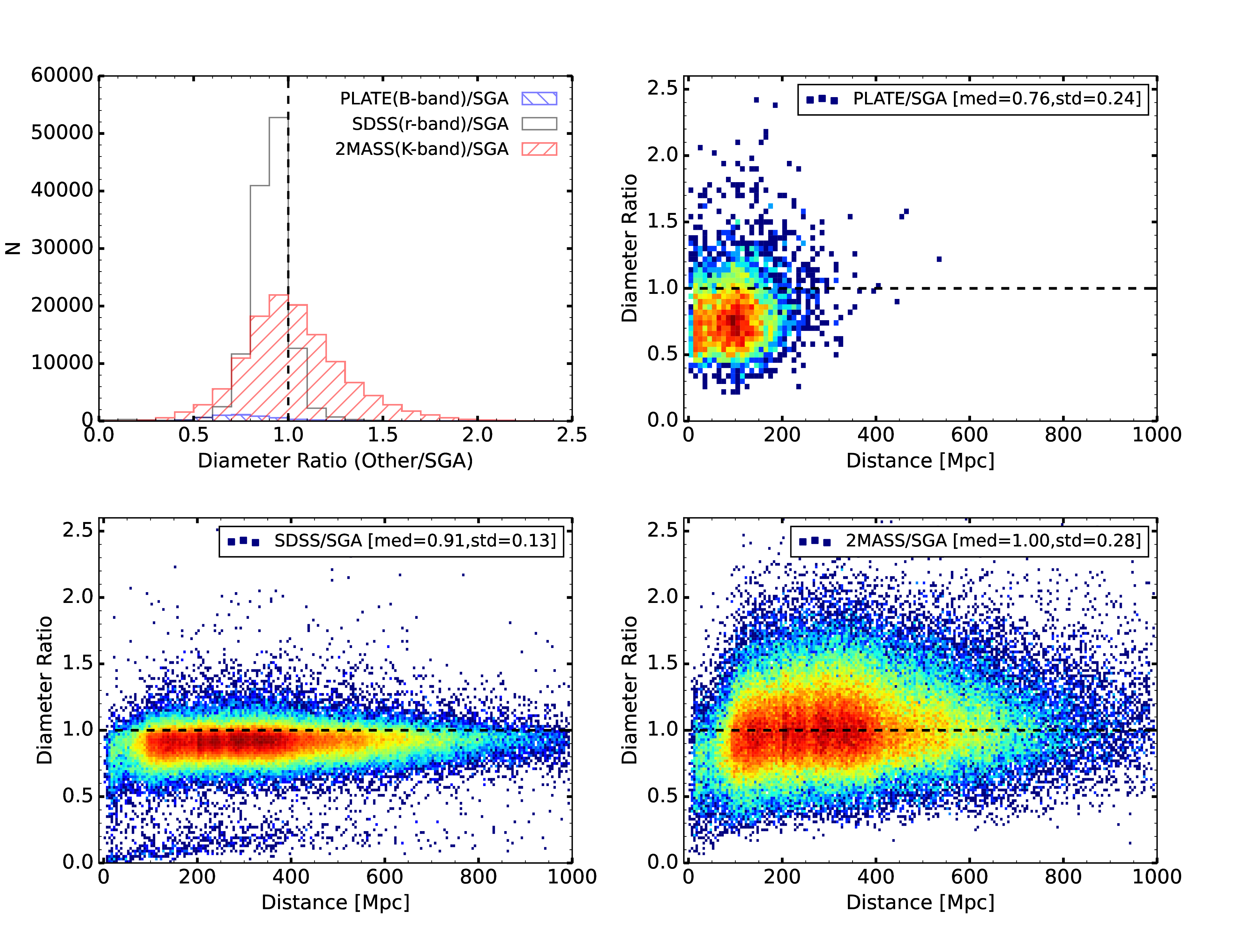
We investigate these previous findings with the diameters collected for NED-LVS, where ~120K galaxies have diameters from 3 surveys (SGA, SDSS, and 2MASS) and ~5K have diameters from all 4 surveys. The 4-panel figure below shows the diameter ratios relative to those of SGA (given the deeper imaging used to measure these diameters). We find that the median diameter ratios relative to SGA are 0.9, 1.0, and 0.75 for D25SDSS/D25SGA, Dtot2MASS/D25SGA, and D25PLATE/D25SGA, respectively. Thus our chosen diameter definitions provide statistically similar values across surveys, diameter definitions, and filters. We note that the PLATE diameters tend to have the largest offset relative to SGA (D25PLATE/D25SGA ~0.75) indicating that the PLATE diameters should be given lower selection priority than SDSS and 2MASS.
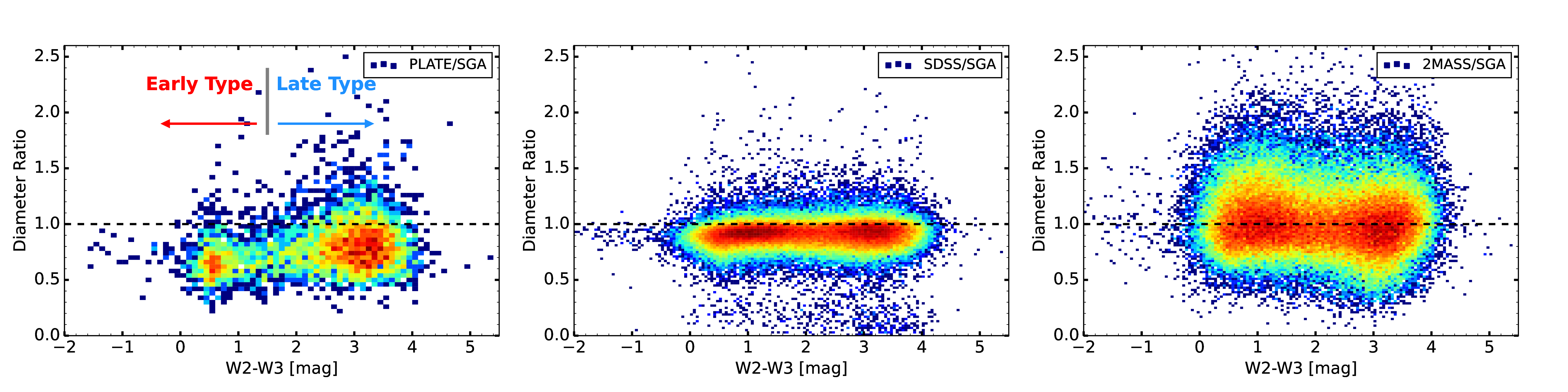
We also investigate diameter ratios as a function of WISE colors to test the systematic trends with galaxy type noted by Jarrett et al. 2003↗ that were found using 2MASS-to-RC3 diameter ratios. The W2-W3 color is a proxy for star formation and galaxy type given that the W2 band traces an evolved stellar population and the W3 band is dominated by the 11.3 μm PAH feature which traces star formation. We do not confirm a difference in NIR-to-optical diameter ratios when using 2MASS and SGA measurements (Dtot2MASS/D25SGA) across WISE colors (right panel of the Figure below; early type galaxies reside on the left side of the plot). However, we do see a systematic trend for D25PLATE/D25SGA diameter ratios (left panel), which suggests that the trend found by Jarrett et al. 2003↗ are caused by the PLATE diameters (either subtle biases in the photographic plate measurements or sample selection) and not a difference between the inherent isophotal optical and "total" NIR diameters. Consequently, the consistency between Dtot2MASS and D25SGA gives further confidence that we can draw diameters from the NIR and optical to produce a roughly consistent fiducial value.
The selection of a fiducial diameter in NED-LVS is as follows (in priority order): the SGA isophotal D25SGA in the r-band, the SDSS isophotal D25SDSS in the r-band, the 2MASS "total" aperture diameter (Dtot2MASS) in the Ks-band, and the PLATE isophotal D25PLATE in the B-band. The isophotal D25 diameters are chosen over the half-light radii due to their larger extents and since the NIR-to-optical half-light radii have shown larger offsets than the NIR "total"-to-optical D25 diameters (Jarrett et al. 2003↗). The SGA diameters are given the highest priority since they are derived from deeper imaging providing more robust measurements. The SDSS diameters are given the second highest priority since they are derived from imaging in the same band and using the same diameter definition as those from SGA. The 2MASS diameters are given priority over the PLATE diameters due to the larger statistical offset and systematic trends across WISE colors (and hence galaxy type) exhibited by the PLATE-to-SGA diameter ratios that are not observed in the 2MASS-to-SGA ratios. PLATE diameters are selected only in cases where a more reliable digital measurements are not available.
| Column | Unit | Description |
|---|---|---|
|
Diam |
arcsec |
Angular major-axis diameter (2a) |
|
Diam_ra |
deg |
Right Ascension (J2000) from the survey indicated in Diam_survey |
|
Diam_dec |
deg |
Declination (J2000) from the survey indicated in Diam_survey |
|
Diam_ba |
... |
Minor-to-major axis ratio |
|
Diam_pa |
deg |
Ellipse position angle (measured east of north) |
|
Diam_survey |
... |
String indicating the survey that made the diameter measurement [SGA, SDSS, 2MASS, PLATE] |
|
Diam_filt |
... |
The filter with which the diameter measurement was made [B, r, Ks] |
|
Diam_refcode |
... |
Reference code for the publication that provided the diameter |
|
Diam_qual |
... |
A boolean quality flag indicating that the diameter properties may be highly uncertain [True=uncertain] |
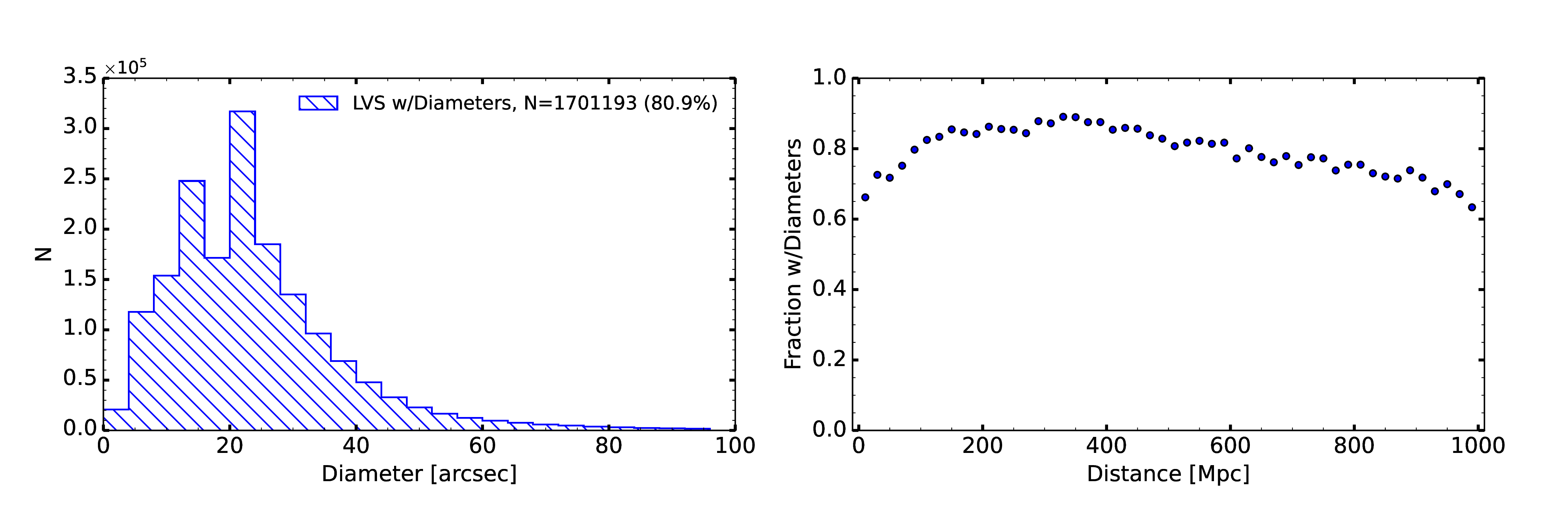
Using the selection priority above, the total number of NED-LVS objects with a fiducial diameter is 1,701,193 (~81%), where 15.7% are from SGA, 35.1% are from SDSS, 29.9% are from 2MASS, 0.1% (N~2,100) are from PLATE surveys. The table above describes the new columns in the NED-LVS file. The left panel of the figure below shows the distribution of the fiducial diameters in NED-LVS, where the peak is near 20 arcsec with a significant tail towards higher values. The 3 galaxies with the largest diameters are the LMC (~650 arcmin), SMC (~316 arcmin), and M31 (~100 arcmin) as would be expected. Of the galaxies with diameters larger than 2 arcmin, ~70% have the fiducial diameters derived from the highest priority source (SGA) showing that the diameters for the largest NED-LVS galaxies are robust. The right panel of the figure below shows the fraction of NED-LVS galaxies that have a fiducial diameter as a function of distance with a bin size of 20 Mpc. We find that this fraction peaks at 300 Mpc at ~90% and slowly decreases to 60% at the furthest distances. The reduced fraction in the closest bin (D < 20 Mpc) is an artifact that is still under investigation.
Several quality checks were performed on the NED-LVS fiducial diameters, one of which resulted in setting a boolean quality flag. An investigation of the separations between the NED-LVS fiducial coordinates ("ra" and "dec") and the coordinates reported in the reference survey ("Diam_ra" and "Diam_dec") relative to the extent of the galaxies revealed that 2,006 galaxies have "normalized separations" -- defined as the separation divided by the semi-major axis radius -- greater than 1 (i.e., one of the locations was outside of the galaxy radius). All of these objects have their "Diam_qual" values set to "True" indicating that the diameter properties may be highly uncertain, and visual inspection was performed on all galaxies grouped by the survey source. The survey coordinates of the PLATE diameters (N~1300) showed no match to any galaxy visible on the deep Legacy Survey images. For these objects, the NED fiducial coordinates do match to galaxies with visual properties (extent and position angle) that match the diameter properties listed in the survey, and we recommend that the NED fiducial coordinates ("ra" and "dec") are used as the diameter position for objects with "Diam_qual" = True and "Diam_survey" = PLATE. The remaining ~700 objects with large normalized separations show different galaxies at the NED fiducial and survey coordinates which could be the result of incorrect matches. Further investigations into the objects with "Diam_qual" values set to "True" and possible solutions are underway, and will be addressed in a future update to NED-LVS. We note that 99% of all NED-LVS objects with diameters show separations less than 3 arcseconds.
Here we list a few known issues that will be addressed in the near future:
- The D25PLATE/D25SGA diameter ratios show larger offsets and a systematic trend across WISE colors compared to other surveys considered here. However, the PLATE diameters are still roughly consistent and useful when no other diameter measurements are available (~2000 galaxies), but should be used with caution.
- N~500 objects with diameters from the PLATE surveys have minor-to-major axis ratios ("Diam_ba") and no position angle ("Diam_pa") given. Visual inspection shows that many have radial profiles consistent with a circle, but all of these diameters should be used with caution.
- N~200K objects with the position angle ("Diam_pa") for 2MASS-XSC is set to 90 degrees. Half have minor-to-major axis ratios ("Diam_ba") equal to 1 indicating a default value for a circular shape, but the other half have "Diam_ba" values less than 1 indicating non-circular shapes; however, these diameters are still considered valid.
- N~200 objects in NED-LVS that have a normalized separation > 1 are listed as having an objtype of "GPair" or "GTrpl". Investigation into the validity of assigning diameters to pair or triple systems will be addressed in a future update to NED-LVS.
- There are a few 100s of objects that show unusually low and high physical sizes (computed for validation purposes), which are likely due to incorrect redshifts. Users should take note of the "z_qual" = True flags and be aware of the potential for other uncertain redshifts when computing physical properties of NED-LVS galaxies. Identifying uncertain redshifts in NED-LVS is an on-going activity and more will be flagged and updated in future versions of NED-LVS.
Publication Version of NED-LVS (2021-09-22)
The version of NED-LVS that corresponds to the analysis of Cook et. al (2023)↗ can be downloaded here.
Citation of NED-LVS
If you use the NED-LVS in your research, please cite both the publication (Cook et. al (2023)↗) and the Digital Object Identifier (DOI): 10.26132/NED8
Last update: April 27, 2026


